Site Credits
Design: strom.works
Development: IntelligentWP
Hosting: Intelligent Hosting
Wiseled provides optical identification, IR illumination and active deterrence systems for critical infrastructure protection.
Energy generation and distribution, water, transport, communications – the infrastructure that sustains modern economies is increasingly a target. State and near-state actors now regularly plan and execute attacks against assets that were previously considered outside the scope of direct military action. The threat picture for critical infrastructure operators has changed permanently, and the protection requirements have changed with it.
The consequence is a gap in the market. Standard commercial security provision – CCTV, access control, perimeter fencing – is insufficient for the threat level that critical infrastructure now faces. Full military-specification procurement is inaccessible for most privately owned infrastructure operators in terms of budget, procurement process and regulatory framework. The W-Q62 CIP ecosystem and FALCON platform are designed for the gap between those two extremes.
Mature CIP deployments typically combine wide-area radar detection with thermal imaging for perimeter monitoring. These systems perform well at what they are designed to do: detecting that something is present. Radar provides accurate track data. Thermal imaging confirms presence and approximate classification.
What neither layer provides is positive optical identification at range in darkness, or any active deterrence capability short of requesting a physical security response. The time between radar detection and physical intervention – often several minutes for large or remote sites – is precisely when optical identification and active deterrence are most valuable.
Wiseled’s CIP capability operates in that gap. Precision IR illumination enables positive optical identification of confirmed intruders at ranges and in conditions where thermal alone is insufficient. White light deterrence and green laser dazzle provide a proportionate, scalable non-lethal response that can be initiated before physical intervention is required.
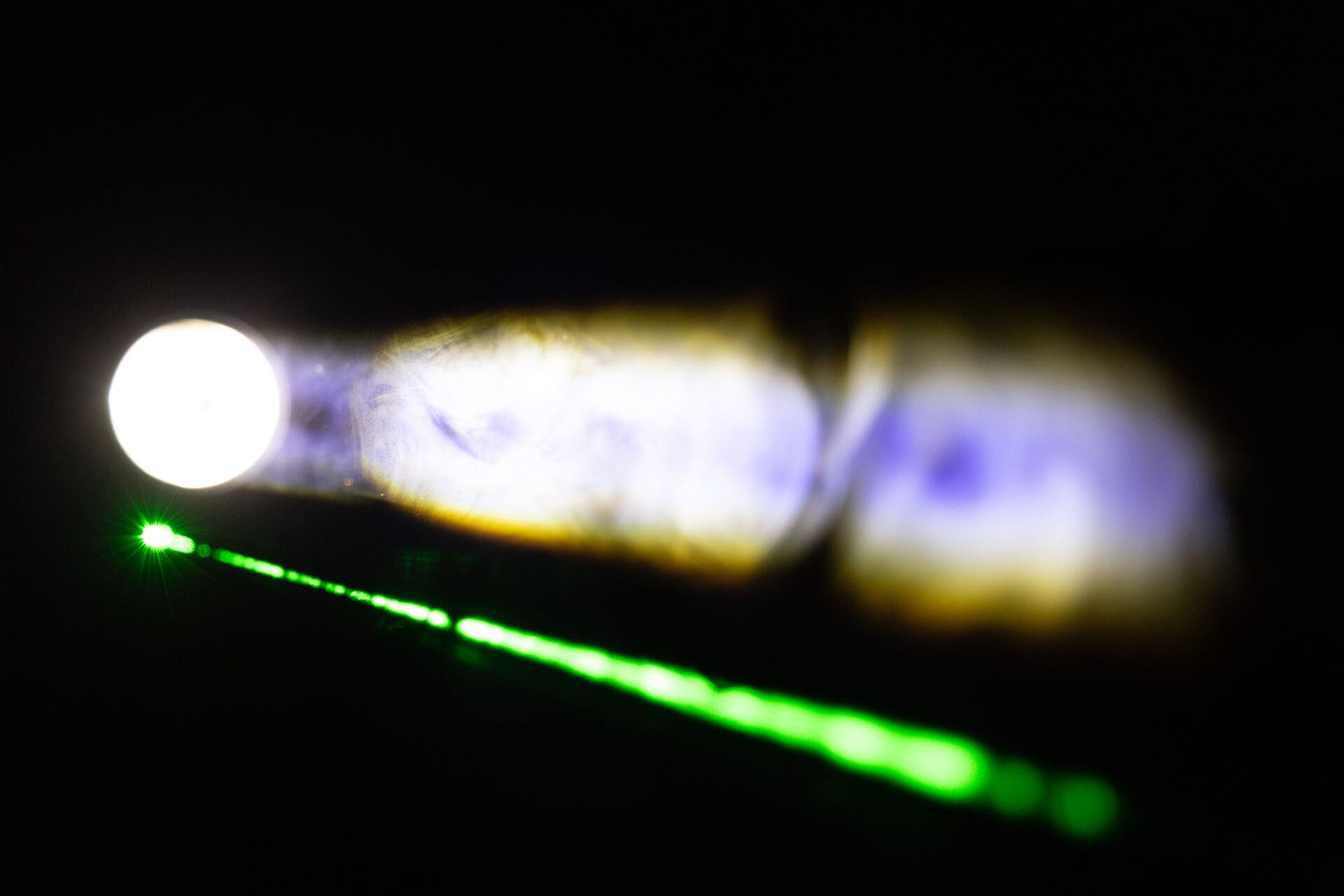
The W-Q62 CIP configuration uses 940 nm infrared illumination to extend the optical channel’s identification capability into complete darkness. The illumination beam tracks the PTZ zoom state, maintaining consistent target coverage as the system closes range on a cued contact from the radar detection layer.
The result is a positive visual identification capability at ranges and in conditions that passive thermal imaging cannot reliably support.
The W-Q62’s integrated thermal channel provides continuous passive monitoring between cued events. Thermal imaging handles wide-area detection in complete darkness, through light rain and in high-contrast lighting conditions where visible cameras perform poorly.
The thermal layer drives alarm triggering; the optical layer with Wiseled IR illumination handles identification once a contact is confirmed.
The W-Q62 CIP configuration supports three deterrence outputs, operable independently or in sequence as part of a graduated response protocol:
See also: